Links
Important Dates
Last date for full Submission Deadline:
April 30, 2026
Last date for full Notification of Acceptance:
May 31, 2026
Last date for full Camera Ready Submission:
June 30, 2026
Contact Us
Conference Secretary
contact@icitsac.com
Luoyang
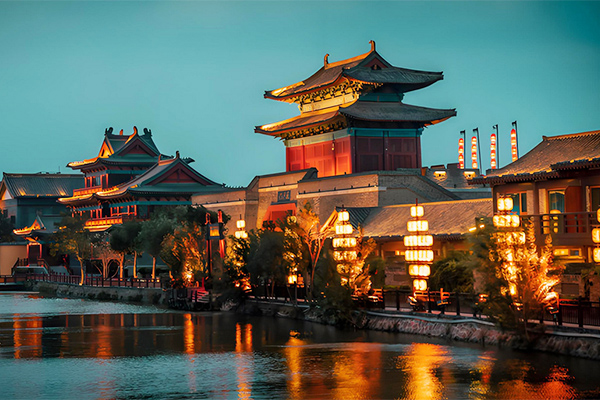
Luoyang is located in the western part of Henan province, stretching across the middle reaches of the Yellow River. As a city famous for its splendid history and profound culture, Luoyang has become a shining gem in central part of China for its abundant and characteristic modern civilization. It has been known as "an ancient capital of nine dynasties". It is among the first cities to be declared by the State Council as the ancient capitals and famous historical and cultural cities. It served as a capital for 1,529 years, and thus of the 7 great ancient capitals in China, it was the first one to have served as the capital for the most numerous dynasties and for the longest time. Luoyang is one of the top tourist cities in China with its numerous cultural relics dotted everywhere, picturesque landscape and national flower-Tree Peony.
Longmen Grottoes
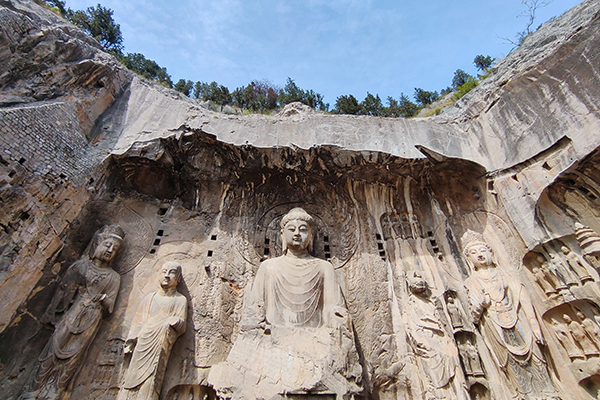
Longmen Grottoes is located at the foot of Yique Mountain, 12km south of Luoyang City proper, where Yi River traverses northward between two mountain peaks which are just like a pair of Chinese gate towers. Indeed, Yique, the name of the mountain, actually means "gate of Yi River" in Chinese, and Emperor Yang of the Sui Dynasty, when enjoying the beauty here, exclaimed with admiration, "Isn't this the Dragon Gate!" and that is the origin of the name: Longmen, the "dragon gate" in Chinese. The rocks of the mountain are hard and tough, quite ideal for stone sculpture, and Longmen Grottoes are the third cluster of cave temples commissioned by the imperial court, after Dunhuang Grottoes in Gansu and Yungang Grottoes in Datong of Shanxi. The carving began in the North Wei dynasty, and went on through East and West Wei Dynasties, then the dynasties of North, North Zhou, Sui, Tang, and the Five Dynasties Period, lasting for over 400 years. During this long period, the full-scale and efficient carvings account for about 150 years.
Laojun Mountain
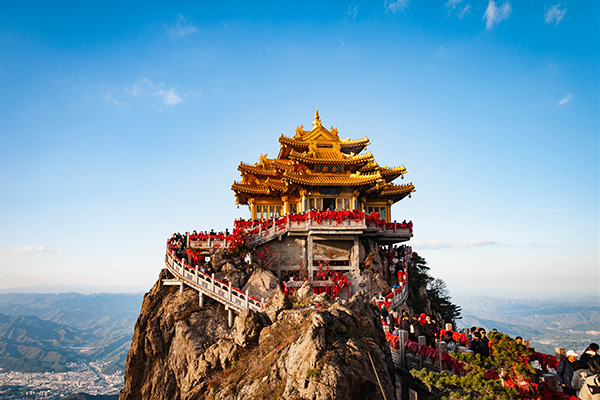
The Laojun Mountain is located two and a half hours south-west of Luoyang. Mount Laojun is one of the most popular destinations in Henan Province. It is part of the Qinling Mountain Range, which divides China between North and South, running through the respective provinces of Gansu, Shaanxi and Henan, and the Funiu Mountain Range, which extends over 400 km through Shanxi Province and into Henan. Laojun is the highest peak of the Funiu Mountains, with a height of 2217m. The mountain owes its name to the famous philosopher Lao Tzu, founder of Taoism, who resided on the mountain as a hermit. A 38m high bronze statue was erected in 2010 on Laojun in his honor. It offers a spectacular view of the region and reveals the distinctive features of the mountain: small waterfalls, green trees, rocks with original shapes, etc.. A gilded-roof pavilion at the top of the mountain attracts the majority of visitors. In addition to its spectacular landscapes with peaks of various shapes, not far from the mountain are the Jiguan limestone caves, more than 800 million years old. With a depth of more than 5600m and a height of 138m, they have no less than 8 different sites to visit.